Business License

POM Shrinkage and Mold Design: Holding Tolerances on Precision Parts
A medical device maker once machined a mold for an acetal valve body using a generic 2.0% shrinkage allowance. The first trial parts came out 0.08 mm undersized on a critical bore, and every subsequent adjustment cost weeks of tooling time. The root cause was not the mold shop; it was assuming a single shrinkage number for POM.
Polyoxymethylene, better known as POM or acetal, is prized precisely because it holds tight tolerances, yet its shrinkage behavior is more complex than most datasheets suggest. Molders who ignore that complexity end up with warped gears, loose press fits, and rejected batches.
This guide explains what drives POM shrinkage, how to budget for it in the tool, and how to keep precision parts inside spec from the first trial run.
1. What POM Shrinkage Actually Means
Shrinkage is the difference between the mold cavity dimension and the cooled part dimension, expressed as a percentage of the cavity size. When molten POM cools from roughly 200°C to room temperature, the polymer chains pack into crystals, and the part contracts.
Two mechanisms combine during cooling: thermal contraction, which every material experiences, and crystallization, which is specific to semi-crystalline polymers like POM. Crystallization shrinks the volume further and is the reason POM shrinks more than amorphous plastics such as ABS.
A typical acetal copolymer datasheet lists mold shrinkage of 1.8 to 2.2%, but that range hides the real picture. Actual shrinkage depends on wall thickness, flow direction, gate design, and processing conditions, and it can drift outside the datasheet range in real tools.
Shrinkage is normally measured after the part has cooled and stabilized for a set period, often 24 to 48 hours after molding. Some of the contraction continues for a while as the polymer relaxes, so measuring parts immediately after ejection gives numbers that do not match final dimensions. Designers and quality teams should agree on a measurement schedule to avoid disputes.
2. Why Shrinkage Matters More for POM Than for Most Plastics
POM parts are usually precision components: gears, bushings, valve seats, pump rotors, and snap-fit housings where tenths of a millimeter decide whether the part works. A gear tooth profile that shrinks unevenly produces noise, vibration, and premature wear.
Press-fit assemblies are especially sensitive. If a POM bushing shrinks more than budgeted, the outer diameter comes up loose in the housing, and the part rotates or rattles in service. Overcompensating in the other direction cracks the housing during assembly.
The tolerance sensitivity of POM means shrinkage is not a one-time calculation. It is a design parameter that must be planned, measured, and controlled across the whole process.
Consider a molded gear as an example. The tooth flanks, the hub bore, and the web all shrink at slightly different rates, and the resulting geometry error shows up as gear noise and backlash problems in the assembled product. A mold that was compensated with real trial data, rather than a generic allowance, produces gears that mesh quietly from the first batch.
3. Typical Shrinkage Values and What Changes Them
Published shrinkage for POM homopolymer is often listed at 2.0 to 2.2%, while copolymer grades commonly show 1.8 to 2.0%. Both are higher than the 0.4 to 0.7% typical of ABS, which surprises molders who switch materials casually.
The table below summarizes how key variables shift shrinkage in practice. Treat the numbers as starting points, not guarantees.
| Variable | Effect on Shrinkage | Typical Range |
|---|---|---|
| Wall thickness | Thicker walls shrink more | 1.8–2.4% at 3 mm |
| Flow direction | More shrinkage along flow | +0.1–0.3% parallel |
| Mold temperature | Higher mold temp raises shrinkage | 80–120°C typical |
| Holding pressure | Higher pack pressure lowers shrinkage | 60–120 MPa |
| Gate size | Small gates can starve packing | varies by part |
Anisotropy is part of the picture as well. Because POM molecules orient along the flow direction during filling, shrinkage is often slightly higher parallel to flow than perpendicular to it. The difference is usually 0.1 to 0.3 percentage points, and it matters most for long, narrow parts where the flow path dominates the geometry. Ailide Polymer (Jiangsu) can supply the grade-specific shrinkage data before you commit to a tool.
4. Homopolymer vs Copolymer: Shrinkage Differences
The two POM families shrink slightly differently. Homopolymer acetal, with its higher crystallinity, tends to shrink a little more and can show more part-to-part variation. Copolymer acetal, such as KOCETAL POM K300 and Formosa POM FM090, offers more uniform shrinkage and better thermal stability.
For tight-tolerance production, many molders prefer copolymer grades precisely because of that uniformity. A consistent 1.9% is easier to design for than an average 2.1% that wanders between 1.9 and 2.3%.
At Ailide Polymer (Jiangsu) Co Ltd, we supply both KOCETAL POM K300 and Formosa POM FM090 to molders, and the grade choice is usually driven by shrinkage consistency as much as by mechanical properties. Confirm the exact grade with your resin supplier and use its published shrinkage range, not a generic number, when the tool is designed.
5. How Wall Thickness Affects Shrinkage
Wall thickness is the single most important geometry factor in POM shrinkage. A thin 1 mm wall cools fast, crystallizes less, and shrinks toward the low end of the range; a thick 4 mm section cools slowly, crystallizes more, and shrinks more.
The same part can therefore have different shrinkage in different sections. A gear hub that is 5 mm thick will shrink more than its 2 mm rim, which distorts the tooth geometry if the tool is not corrected.
Designers should aim for uniform wall thickness wherever possible. When sections must vary, plan the shrinkage allowance section by section and discuss the transition areas with the mold maker before steel is cut. Our engineers at Ailide Polymer can review the part geometry against the grade data before the tool is committed.
Rib and boss design deserves special attention in POM parts. A boss wall should be roughly 60 to 75% of the nominal wall thickness to avoid sink marks, and ribs should be thinner at the base than the wall they support. These proportions keep thick sections small enough that they shrink close to the surrounding material.
6. Processing Parameters That Shift Shrinkage
Mold temperature has a direct effect on shrinkage. Running the mold at 90°C instead of 60°C slows cooling, raises crystallinity, and typically increases shrinkage by 0.1 to 0.3 percentage points.
Holding pressure and holding time control how much material is packed into the cavity before the gate freezes. Higher pack pressure reduces shrinkage, while premature gate freeze leaves the part underpacked and oversized in shrinkage.
Melt temperature and injection speed play secondary roles, but they matter for consistency. The practical advice is to fix a processing window during mold trials and document it, because changing any of these parameters later changes part dimensions.
Annealing is sometimes used to stabilize POM parts after molding. Heating the parts to roughly 140 to 150°C for a short period relieves internal stress and allows most of the post-mold shrinkage to occur in a controlled way. It adds a process step, so it is reserved for parts where long-term dimensional stability is critical.
7. Mold Design Strategies for Tighter Tolerances
Gate placement controls how the cavity fills and packs. For a precision POM part, the gate should be positioned to promote uniform packing and avoid late-shrinkage effects at the far end of the flow path.
Cooling circuit design is equally important. Balanced cooling keeps the part temperature uniform while it crystallizes, reducing differential shrinkage that causes warpage. Short, direct cooling lines beat long serpentine ones in most precision tools.
Venting prevents trapped gas from creating localized density differences. A well-vented cavity fills more consistently, which translates into more consistent shrinkage part to part.
Ejection and part handling also affect the final dimensions. A POM part ejected too hot, while still crystallizing, can distort under its own weight or the ejector pins. Cooling the part in the mold until it is stiff enough to handle, and using enough ejector pins to push evenly, protects the geometry you designed for.
8. Warpage and Sink Marks: The Side Effects of Shrinkage
Differential shrinkage is what produces warpage. When one section shrinks more than a neighboring section, internal stresses pull the part out of shape, and the part bows or twists after ejection.
Sink marks are the opposite problem: a thick boss or rib creates a local void or surface depression because the thick section shrinks more than the thin skin around it. Both defects trace back to uneven cooling and packing.
Mitigation follows the same playbook: uniform walls, balanced cooling, correct gate placement, and holding pressure applied long enough to feed the thick sections. In stubborn cases, rib redesign or core-cavity temperature offset helps.
A practical example shows how much control matters. A while back, a gear producer found its acetal parts bowing by 0.2 mm across a 40 mm face. The fix was not a new tool; it was raising the mold temperature by 15°C and extending the holding time by 2 seconds, which balanced the cooling enough to bring the parts into spec.
9. Realistic Tolerances: What POM Can Actually Hold
With a properly designed tool and a controlled process, POM holds commercial tolerances of roughly ±0.1% of dimension, and precision tools reach ±0.05% or better on critical features. That is why acetal is the default for gears and bearings.
What POM cannot do is hold those numbers without process control. A mold that runs at 70°C one day and 95°C the next will produce parts that drift out of spec even though the tool is built correctly.
The table below gives realistic tolerance guidance for a typical injection-molded POM part.
| Feature | Commercial Tolerance | Precision Tolerance |
|---|---|---|
| Dimensions up to 30 mm | ±0.10 mm | ±0.03 mm |
| Dimensions 30–100 mm | ±0.20 mm | ±0.08 mm |
| Hole-to-hole centers | ±0.15 mm | ±0.05 mm |
| Concentricity | ±0.15 mm | ±0.05 mm |
Post-mold aging is worth planning for as well. POM continues to shrink very slightly over days and weeks as the polymer relaxes, typically less than 0.1% for a well-processed part. Assemblies that rely on press fits should account for this slow drift, and critical parts should be measured on a schedule that captures it. The practical takeaway is to sample parts at the same age throughout production, so the numbers you compare are actually comparable.
10. FAQ About POM Shrinkage
10.1 What is the typical shrinkage of POM?
Most POM grades shrink between 1.8% and 2.2%, with homopolymer grades at the higher end and copolymer grades typically at 1.8 to 2.0%. Actual shrinkage depends on wall thickness, flow direction, mold temperature, and packing pressure. Always use the shrinkage range from the specific grade datasheet and verify it with a mold trial rather than relying on a general industry figure. The datasheet number is a starting point, not the final truth for your tool.
10.2 How do I compensate for shrinkage in the mold?
Set the cavity dimensions using the grade's shrinkage allowance, then add generous draft angles and design the gate and cooling for uniform packing. A common practice is to build the tool slightly oversize and make trial adjustments, but a better approach is to use the supplier's actual shrinkage data from the start. Ailide Polymer can provide the measured shrinkage range for KOCETAL POM K300 and Formosa POM FM090 before the design is finalized. Document the processing window during trials so the compensation stays valid in production.
10.3 Why is my POM part warping after molding?
Warpage in POM usually comes from differential shrinkage: different wall thicknesses, uneven cooling, or unbalanced filling create internal stress that bends the part. Check whether the wall sections are uniform, whether the cooling circuits are balanced, and whether the holding pressure is sufficient. Mold temperature control is often the fix, because running a steady, uniform mold temperature reduces the stress that causes warpage.
10.4 Does POM shrink more than ABS?
Yes, significantly. POM shrinks roughly 1.8 to 2.2% while ABS shrinks about 0.4 to 0.7%, because POM is semi-crystalline and contracts further during crystallization. If you switch a part from ABS to POM, the mold must be rebuilt with the new shrinkage allowance, and the gate and cooling design should be reviewed as well. This is one of the most common reasons an ABS mold cannot simply be reused for acetal.
Recently Posted
-
ABS in Automotive Interiors: From Dashboards to Door Panels
September 2, 2026A tier-two supplier once substituted a general-purpose ABS for an automotive-grade ABS on a door trim component to save 4% on resi Read More
 -
ABS Flame Retardant Grades and UL 94 Ratings Explained: A Practical Guide for Buyers and Designers
September 2, 2026An electronics manufacturer once submitted a power-supply housing molded from standard ABS to a safety certification test. The mat Read More
 -
KOCETAL K300 vs Formosa FM090 vs DURACON M90: Picking the Right Medium-Viscosity POM
September 2, 2026A gear shop in India once ordered a container of acetal copolymer based on a 5% price discount, without checking whether the grade Read More
 -
PP vs PE: Which Polyolefin Resin Fits Your Application?
September 2, 2026A bottle manufacturer once chose HDPE for a hot-fill juice container and watched the bottles distort on the filling line. The mate Read More

Contact Us
Recommended Products
-
 Automotive Interior Clip and Door Lock POM K300 Injection Molding Material With Low FrictionNegotiableMOQ: 1 Kilogram
 -
KOCETAL POM K300 Virgin Pellets For Precision Gear Bearing Automotive Latch Water Valve PartsNegotiableMOQ: 1 Kilogram
-
Original Kolon POM K300 Engineering Plastic Wear Resistant Self Lubricating Acetal GranulesNegotiableMOQ: 1 Kilogram
-
Self-Lubricating POM K300 HDT 120°C Wear Resistant Resin With 0.2% Moisture AbsorptionNegotiableMOQ: 1 Kilogram
-
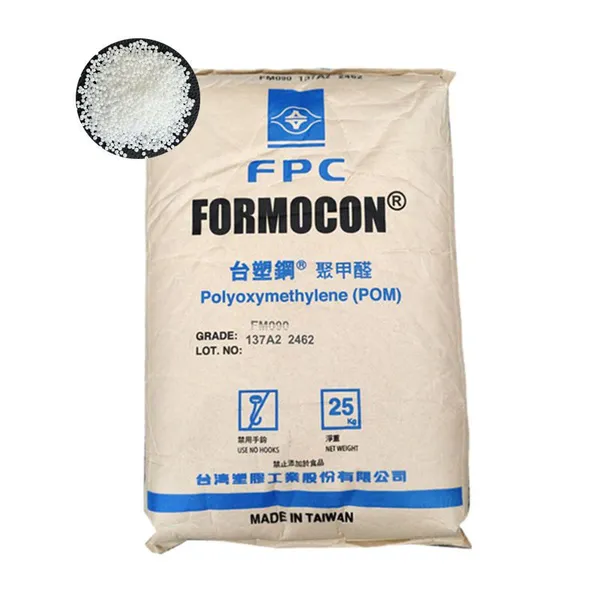
POM FM090AW PTFE Filled Wear Resistant Low Friction Acetal for Silent GearsNegotiableMOQ: 1 Kilogram
-
POM FM090 General Purpose Acetal Copolymer With Excellent MachinabilityNegotiableMOQ: 1 Kilogram
-
POM FM090 Standard Flow Acetal Copolymer Granules for Precision Injection MoldingNegotiableMOQ: 1 Kilogram
-
POM FM090 UV Stabilized Acetal Resin for Outdoor Automotive ComponentsNegotiableMOQ: 1 Kilogram
-
Technical Support Available POM K300 Acetal Copolymer for Precision Injection Molding ServiceNegotiableMOQ: 1 Kilogram
-
KOCETAL POM K300 Acetal Copolymer MFR 9 G/10min 1.41g/cm³ Tensile Strength 60MPaNegotiableMOQ: 1 Kilogram
-
Factory Price Polyacetal POM Resin FM090 for Engineering ApplicationsNegotiableMOQ: 1 Kilogram
-
High Strength Cheap POM FM090 UV Engineering Plastic for Automotive PartsNegotiableMOQ: 1 Kilogram
-
Virgin POM FM090 Granules Pellets Engineering Plastic Raw MaterialNegotiableMOQ: 1 Kilogram
-
POM K300 Plastic Granules 1.5% Shrinkage Rate 80 Shore D Hardness Stable Injection Molding PerformanceNegotiableMOQ: 1 Kilogram
-
Low Friction Coefficient High Dimensional Stability POM K300 Acetal Copolymer Injection Molding GradeNegotiableMOQ: 1 Kilogram

-
POM K300 Acetal Sheet Used for Automotive Gear Components and Conveyor Chains in Industrial MachineryNegotiableMOQ: 1 Kilogram
-
POM K300 Engineering Plastic Sheet With Melting Point 165°C and Excellent Wear Resistance for MachiningNegotiableMOQ: 1 Kilogram
-
POM K300 Acetal Copolymer Injection Molding Grade With Low Friction Coefficient and High Dimensional StabilityNegotiableMOQ: 1 Kilogram
-
POM K300 Polyoxymethylene Resin MFI 9 Engineering Plastic Granule for Injection MoldingNegotiableMOQ: 1 Kilogram
-
Virgin POM Granules Polyoxymethylene Pellets Manufacturer Direct Price for Injection MoldingNegotiableMOQ: 1 Kilogram