Business License

POM vs Nylon: How to Choose the Right Engineering Plastic
The best choice between POM and nylon depends on your application's load, temperature, moisture exposure, and wear requirements. POM (polyoxymethylene) excels in low-friction, dimensionally stable precision parts. Nylon (polyamide) offers higher toughness, impact resistance, and load-bearing capacity in dry-to-moderate environments. Both are widely used engineering plastics, but selecting the wrong grade can lead to premature part failure, dimensional instability, or unnecessary cost.
A design engineer at a Suzhou automation equipment manufacturer recently faced exactly this decision. Their team needed a wear-resistant gear for a compact conveyor drive, and the initial specification called for PA66 because of its strength reputation.
After molding and testing, the gears swelled during the humid summer months. Meshing issues followed, along with unacceptable noise. Switching to a POM grade with low moisture absorption solved the problem. The parts held tighter tolerances, ran quieter, and reduced the need for post-machining.
You have likely encountered a similar situation: two materials look comparable on paper, but performance diverges once parts are in service. This guide compares POM and nylon across mechanical properties, thermal behavior, chemical resistance, processing, and cost. You will learn when to specify each material, where they overlap, and how to avoid the most common selection mistakes.
Key Takeaways
POM delivers better dimensional stability and lower friction than nylon, making it the safer choice for tight-tolerance gears, bearings, and sliding parts.
Nylon offers higher toughness, impact strength, and load capacity in dry conditions, but absorbs moisture that can cause swelling and property changes.
POM requires minimal drying and is easier to mold to tight tolerances; nylon must be dried thoroughly before processing and monitored for moisture regain in service.
For wet or high-humidity environments, POM generally outperforms unreinforced nylon unless the nylon is specially formulated or reinforced.
Both materials are available from authorized global suppliers such as DuPont, Polyplastics, and BASF through distributors who provide batch documentation and technical support.
What Are POM and Nylon?
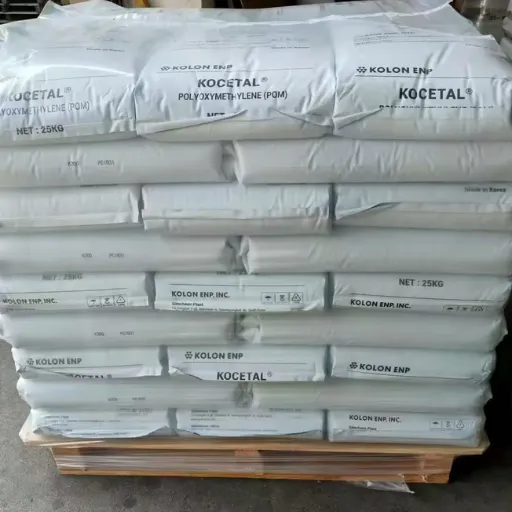
Polyoxymethylene (POM)
Polyoxymethylene (POM), also called acetal or polyacetal, is a high-crystallinity thermoplastic known for stiffness, low friction, and excellent dimensional stability. It is commonly used for precision mechanical components such as gears, bearings, bushings, and automotive fuel-system parts. POM materials are available as homopolymer and copolymer grades. Homopolymers such as DuPont Delrin offer slightly higher mechanical properties and hardness, while copolymers such as Polyplastics DURACON provide better chemical resistance and thermal stability.
POM's crystalline structure gives it low creep under mechanical load and excellent fatigue resistance. It machines well, maintains tight tolerances after molding, and has a low coefficient of friction against metals and other plastics. These properties make it a default choice for moving parts where precision matters more than raw impact strength.
Polyamide (PA / Nylon)
Polyamide (PA), commonly called nylon, is a family of engineering plastics that includes PA6, PA66, PA11, PA12, and many reinforced or modified grades. Nylon is valued for high tensile strength, toughness, abrasion resistance, and fatigue performance. Nylon grades are widely used in automotive, industrial, electrical, and consumer applications ranging from cable ties and bearings to under-hood components.
PA66 and PA6 are the most common engineering grades. PA66 has higher heat resistance, stiffness, and lower moisture absorption than PA6. Glass-filled and other reinforced grades further improve strength, heat deflection temperature, and dimensional stability. However, nylon's polarity causes it to absorb moisture from the environment, which can increase dimensions, reduce stiffness, and change electrical properties over time.
Key Property Comparison: POM vs Nylon
Mechanical Properties
POM and nylon both offer high strength and stiffness compared to commodity plastics such as PP or ABS, but their mechanical signatures differ. POM has higher compressive strength and stiffness than unreinforced nylon, along with superior creep resistance. This makes POM a strong candidate for parts under sustained compressive load, such as spring elements, clips, and thrust washers.
Nylon, especially PA66, has higher tensile strength and impact resistance than POM. It can absorb more energy before fracturing, which is important for parts exposed to sudden loads or rough handling. Nylon also shows better resistance to repeated flexing and fatigue in applications such as hinges, living hinges, and cable ties.
When engineers compare these materials for load-bearing parts, they often look at specific modulus and strength-to-weight ratios. In unfilled grades, POM and PA66 are close enough that the final decision usually hinges on moisture exposure, wear behavior, and processing cost rather than raw strength numbers.
Thermal Properties
Nylon generally outperforms POM in high-temperature applications. PA66 has a heat deflection temperature (HDT) around 70–90 °C for unfilled grades and significantly higher for glass-filled grades. POM homopolymer HDT is around 85–100 °C, while copolymer grades are typically 10–15 °C lower. For continuous service temperature, PA66 can often operate up to 120 °C, whereas most POM grades are limited to around 80–95 °C.
If your application sees sustained temperatures above 90 °C, nylon or a heat-stabilized nylon grade is usually the better choice. POM can degrade at elevated temperatures, releasing formaldehyde and causing discoloration or embrittlement. Always check the technical data sheet for the exact HDT and continuous service temperature of the specific grade you are evaluating.
Moisture Absorption and Dimensional Stability
This is where POM and nylon diverge most clearly. Nylon absorbs moisture from ambient air, typically 1.5–3% for PA66 and up to 3.5% or more for PA6 depending on humidity and part thickness. This moisture uptake causes dimensional growth, reduces tensile modulus, and can lower electrical insulation properties. In tight-tolerance parts, even small amounts of swelling can cause assembly problems or functional failure.
POM absorbs very little moisture, usually less than 0.3%. This makes POM the preferred material for precision gears, valves, pumps, and other components where dimensional consistency is critical. If your part will operate in humid, tropical, or wet environments, POM's moisture stability is a significant advantage.
A medical device manufacturer in Guangdong learned this lesson during validation testing. They initially selected PA66 for a small roller in a diagnostic instrument because of its toughness. After accelerated aging at 85% relative humidity, the roller expanded and began binding in its housing. Replacing it with a POM copolymer grade kept dimensional variation within 0.1% and allowed the device to pass validation on schedule.
Wear, Friction, and Lubrication
POM has one of the lowest coefficients of friction among unfilled engineering plastics. It wears well against steel and itself, making it ideal for unlubricated or lightly lubricated sliding and rotating parts. Many POM grades are also available with internal lubricants such as PTFE or silicone to further reduce friction and wear.
Nylon also has good wear resistance, particularly when reinforced with glass fiber or molybdenum disulfide. However, unreinforced nylon can exhibit higher friction than POM, especially when dry. Nylon's toughness advantage becomes more relevant in impact-prone or heavily loaded wear applications where occasional shock loads occur.
For continuous sliding contact with minimal lubrication, POM is usually the better starting point. For abrasive or high-impact wear conditions, reinforced nylon grades may outperform POM.
Chemical Resistance
Both materials resist many hydrocarbons, oils, and greases, but their chemical sensitivities differ. POM copolymers have good resistance to fuels, solvents, and weak acids. POM homopolymers are slightly more sensitive to strong acids and bases. Neither POM nor nylon should be used with strong oxidizing acids or chlorinated solvents.
Nylon resists many oils, greases, and hydrocarbons but is attacked by strong acids and phenols. It also absorbs water, which can affect chemical resistance and mechanical properties in wet environments. For fuel-system components and chemical-handling parts, POM copolymer grades are often specified because of their excellent fuel resistance and dimensional stability.
If you need help matching a material to a specific chemical environment, contact our technical support team for grade-specific guidance.
When to Choose POM Over Nylon
Specify POM when dimensional stability, low friction, and moisture resistance matter more than maximum impact strength. Common POM applications include:
Precision gears and gear racks
Bearings, bushings, and thrust washers
Pump and valve components
Fuel-system parts
Conveyor rollers and guide rails
Springs, clips, and fasteners
Camera and printer mechanisms
POM's low moisture absorption makes it particularly suitable for parts used outdoors, in bathrooms, in food-processing equipment, or anywhere humidity fluctuates. Its excellent machinability also makes it popular for low-volume prototypes and high-precision custom parts.
A mold maker in Ningbo switched from PA66 to POM for a small cam follower in an appliance assembly line. The PA66 followers had expanded slightly during monsoon season, causing inconsistent timing in the indexing mechanism. The POM replacements maintained their dimensions, reduced noise, and allowed the customer to eliminate a secondary sizing operation.
Ready to evaluate POM for your precision parts? Request a quote and technical data sheet for the POM grades in our portfolio.
When to Choose Nylon Over POM
Specify nylon when toughness, impact resistance, and load-bearing capacity are the priority, and moisture exposure can be controlled. Common nylon applications include:
Structural brackets and housings
Cable ties and fasteners
Gears and sprockets in dry environments
Wear pads and slide bearings (especially glass-filled grades)
Electrical connectors and terminal blocks
Automotive under-hood components
Industrial rollers and wheels
Nylon's higher temperature resistance and ability to accept high filler loadings make it versatile for automotive and industrial applications. Glass-filled PA66, for example, can achieve heat deflection temperatures above 200 °C and stiffness comparable to some metals.
For heavy-duty gears that see shock loads and operate in controlled climates, PA66 can be an excellent choice. In dry, indoor environments, nylon often outlasts POM in applications where repeated impact or abrasion occurs. The key is to account for moisture absorption in the design by specifying appropriate tolerances, selecting lower-moisture grades such as PA66, or choosing stabilized formulations.
Processing Considerations for POM and Nylon
Drying Requirements
POM is relatively forgiving when it comes to moisture. Most grades require only light drying, typically at 80–100 °C for 2–4 hours if the material has been exposed to humid air.
Nylon, by contrast, is hygroscopic and must be dried thoroughly before injection molding. PA66 typically requires drying at 80–100 °C for 4–6 hours, while PA6 may need longer. Inadequate drying leads to splay, weak weld lines, and poor surface finish in nylon parts.
Mold Design and Shrinkage
POM has high crystallinity and relatively high shrinkage, typically 1.5–2.5% depending on grade and wall thickness. However, because it absorbs little moisture, molded dimensions remain stable after equilibration. Nylon shrinkage varies more widely, from around 0.8% for glass-filled grades to 1.5–2.2% for unfilled PA66. Post-mold moisture absorption can cause additional dimensional changes that must be anticipated.
Both materials require careful gate design and wall thickness control to minimize sink marks and warpage. POM can be sensitive to gate blush and jetting if gate design is poor. Nylon flows well but can produce weld lines that are weaker than the base material, especially in thick sections.
Surface Finish and Color
POM produces a smooth, hard surface with good gloss. It is available in natural, black, and custom colors. Nylon also molds with a good surface finish, though glass-filled grades will show some fiber texture. For visible consumer parts, unfilled or mineral-filled nylon may provide a better cosmetic appearance than heavily reinforced grades.
Cost and Supply Considerations
Material cost varies by grade, supplier, quantity, and market conditions. In general, commodity POM and unfilled PA66 are comparably priced in the engineering plastics range, with both typically more expensive than PP or ABS but less expensive than specialty polymers such as PEEK or PSU.
Glass-filled and specialty grades of nylon can be significantly more expensive than standard POM. Internally lubricated or UV-stabilized POM grades also carry a premium. For budget-sensitive projects, it is worth comparing the total cost including processing yield, scrap rates, and any secondary operations.
Ailide Polymer distributes POM and nylon from authorized global suppliers including DuPont, Polyplastics, Chi Mei, Formosa Plastics, and BASF. Working with an authorized distributor ensures you receive authentic material with proper documentation, batch traceability, and technical support. This reduces the risk of counterfeit or off-spec resin that can derail qualification and production schedules.
Common Mistakes When Choosing Between POM and Nylon
Selecting between POM and nylon based on brand name or general reputation rather than application requirements is a common error. Here are mistakes we see regularly:
Ignoring moisture absorption. Engineers sometimes specify PA66 for tight-tolerance parts without accounting for humidity-induced swelling. In high-humidity or wet environments, POM or glass-filled nylon is usually a safer choice.
Over-specifying toughness. If the part does not see impact loads, choosing nylon for its toughness may add cost and moisture sensitivity without benefit. POM often delivers equal or better functional performance at lower total cost.
Neglecting continuous service temperature. POM softens and degrades at sustained temperatures above its recommended range. If the part operates near an engine, heater, or electrical component, verify temperature limits carefully.
Forgetting documentation requirements. Automotive, medical, and electrical applications often require material certifications, UL ratings, or regulatory compliance. Verify that the selected grade has the appropriate certificates before finalizing the design.
A procurement manager at a Wuxi electronics housings supplier once ordered a generic PA6 grade to save cost on a connector program. The material lacked the required UL94 flame rating, forcing a last-minute redesign and delaying the customer's product launch. The replacement was a certified PA66 grade with full documentation. The incident added three weeks to the schedule and reinforced the value of specifying grade and certification requirements upfront.
Need help avoiding these pitfalls? Our material selection guide provides a step-by-step framework for matching engineering plastics to application requirements.
POM vs Nylon: Quick Reference Table
| Property | POM (Polyoxymethylene) | Nylon (Polyamide PA66) |
|---|---|---|
| Tensile strength | High | Very high |
| Impact resistance | Good | Very good |
| Moisture absorption | Very low (~0.3%) | Moderate (1.5–3%) |
| Dimensional stability | Excellent | Good, requires design allowance |
| Coefficient of friction | Very low | Low to moderate |
| Heat deflection temp. (unfilled) | ~85–100 °C | ~70–90 °C |
| Continuous service temp. | ~80–95 °C | ~90–120 °C |
| Chemical resistance | Good to fuels, solvents | Good to oils, greases |
| Typical applications | Gears, bearings, fuel parts | Brackets, fasteners, under-hood |
| Processing ease | Easy, low drying required | Requires thorough drying |
This table provides a starting point, but grade-specific data should always come from the technical data sheet. Material databases such as MatWeb and UL Prospector can help you compare published properties across grades and suppliers.
Frequently Asked Questions
Is POM stronger than nylon?
It depends on how you define strength. Nylon, particularly PA66, has higher tensile strength and impact resistance than POM. However, POM has higher compressive strength, stiffness, and creep resistance. For precision parts under sustained load, POM often performs better. For parts exposed to shock or heavy tensile loads, nylon is usually the stronger choice.
Can POM replace nylon in gears?
Yes, POM is often used in place of nylon for gears, especially when dimensional stability, low friction, and quiet operation are important. POM gears run smoothly with minimal lubrication and maintain tight tolerances in humid conditions. Nylon gears may be preferred for heavy loads or impact conditions, particularly when reinforced.
Does nylon absorb water?
Yes, nylon absorbs moisture from the air. PA66 absorbs roughly 1.5% by weight at equilibrium in standard humidity, while PA6 can absorb more. Moisture absorption causes dimensional growth and reduces stiffness. For wet or humid environments, POM or moisture-stabilized nylon grades are better options.
Which is better for outdoor use, POM or nylon?
POM is generally better for outdoor or high-humidity applications because of its low moisture absorption and good dimensional stability. Nylon can be used outdoors if it is UV-stabilized and designed with moisture expansion in mind. For long-term outdoor exposure, consider UV-stabilized grades of either material or consult your supplier for specific recommendations.
Is POM or nylon easier to machine?
Both materials machine well, but POM is often preferred for tight-tolerance machined parts because of its stability and clean chip formation. Nylon can produce stringy chips and may absorb cutting fluid if not handled properly. Always use sharp tools and appropriate speeds and feeds for each material.
Conclusion
Choosing between POM and nylon comes down to matching material behavior to application conditions. POM offers superior dimensional stability, low friction, and moisture resistance, making it ideal for precision gears, bearings, and fuel-system components. Nylon delivers higher toughness, impact strength, and temperature resistance, especially when reinforced, but requires careful handling of moisture absorption.
Before finalizing your material selection, review the specific grade's technical data sheet, consider the operating environment, and verify processing and documentation requirements. Working with an authorized distributor simplifies this process by providing access to certified grades, batch traceability, and application support.
Get the right material for your next project. Request a quote for POM, nylon, or other engineering plastics, and our technical team will help you select a grade that meets your performance, quality, and delivery requirements.
Recently Posted
-
ABS in Automotive Interiors: From Dashboards to Door Panels
September 2, 2026A tier-two supplier once substituted a general-purpose ABS for an automotive-grade ABS on a door trim component to save 4% on resi Read More
 -
ABS Flame Retardant Grades and UL 94 Ratings Explained: A Practical Guide for Buyers and Designers
September 2, 2026An electronics manufacturer once submitted a power-supply housing molded from standard ABS to a safety certification test. The mat Read More
 -
KOCETAL K300 vs Formosa FM090 vs DURACON M90: Picking the Right Medium-Viscosity POM
September 2, 2026A gear shop in India once ordered a container of acetal copolymer based on a 5% price discount, without checking whether the grade Read More
 -
PP vs PE: Which Polyolefin Resin Fits Your Application?
September 2, 2026A bottle manufacturer once chose HDPE for a hot-fill juice container and watched the bottles distort on the filling line. The mate Read More

Contact Us
Recommended Products
-
 Automotive Interior Clip and Door Lock POM K300 Injection Molding Material With Low FrictionNegotiableMOQ: 1 Kilogram
 -
KOCETAL POM K300 Virgin Pellets For Precision Gear Bearing Automotive Latch Water Valve PartsNegotiableMOQ: 1 Kilogram
-
Original Kolon POM K300 Engineering Plastic Wear Resistant Self Lubricating Acetal GranulesNegotiableMOQ: 1 Kilogram
-
Self-Lubricating POM K300 HDT 120°C Wear Resistant Resin With 0.2% Moisture AbsorptionNegotiableMOQ: 1 Kilogram
-
POM FM090AW PTFE Filled Wear Resistant Low Friction Acetal for Silent GearsNegotiableMOQ: 1 Kilogram
-
POM FM090 General Purpose Acetal Copolymer With Excellent MachinabilityNegotiableMOQ: 1 Kilogram
-
POM FM090 Standard Flow Acetal Copolymer Granules for Precision Injection MoldingNegotiableMOQ: 1 Kilogram
-
POM FM090 UV Stabilized Acetal Resin for Outdoor Automotive ComponentsNegotiableMOQ: 1 Kilogram
-
Technical Support Available POM K300 Acetal Copolymer for Precision Injection Molding ServiceNegotiableMOQ: 1 Kilogram
-
KOCETAL POM K300 Acetal Copolymer MFR 9 G/10min 1.41g/cm³ Tensile Strength 60MPaNegotiableMOQ: 1 Kilogram
-
Factory Price Polyacetal POM Resin FM090 for Engineering ApplicationsNegotiableMOQ: 1 Kilogram
-
High Strength Cheap POM FM090 UV Engineering Plastic for Automotive PartsNegotiableMOQ: 1 Kilogram
-
Virgin POM FM090 Granules Pellets Engineering Plastic Raw MaterialNegotiableMOQ: 1 Kilogram
-
POM K300 Plastic Granules 1.5% Shrinkage Rate 80 Shore D Hardness Stable Injection Molding PerformanceNegotiableMOQ: 1 Kilogram
-
Low Friction Coefficient High Dimensional Stability POM K300 Acetal Copolymer Injection Molding GradeNegotiableMOQ: 1 Kilogram

-
POM K300 Acetal Sheet Used for Automotive Gear Components and Conveyor Chains in Industrial MachineryNegotiableMOQ: 1 Kilogram
-
POM K300 Engineering Plastic Sheet With Melting Point 165°C and Excellent Wear Resistance for MachiningNegotiableMOQ: 1 Kilogram
-
POM K300 Acetal Copolymer Injection Molding Grade With Low Friction Coefficient and High Dimensional StabilityNegotiableMOQ: 1 Kilogram
-
POM K300 Polyoxymethylene Resin MFI 9 Engineering Plastic Granule for Injection MoldingNegotiableMOQ: 1 Kilogram
-
Virgin POM Granules Polyoxymethylene Pellets Manufacturer Direct Price for Injection MoldingNegotiableMOQ: 1 Kilogram